Is the curriculum the most outdated technology of film education?
The future of film education will not be determined by new technologies, but by how we reform learning, creative collaboration and educational structures. Observations from the CILECT 2026 World Congress in Dublin.
Marko Luukkonen | 9 November 2026
Filmmaking is changing – will education change too?
The congress of CILECT, the International Association of Film and Television Schools, was held in Dublin from 27 to 31 October 2026. The theme of the event was ‘Film Education: ReMastered’, and it focused on the renewal of film education, changing professional skills requirements, artificial intelligence, artistic research and international collaboration.
CILECT is one of the most significant international collaborative networks in film education. It comprises over 180 film, television and media education institutions from more than 60 countries across six continents. The joint events of the FilmEU Industry Summit, held in conjunction with the Congress, brought together nearly 300 representatives from film education and the audiovisual sector. The congress was held for the first time in Dublin, Ireland, and was hosted by the Institute of Art, Design + Technology (IADT) in collaboration with CILECT and the FilmEU network.
My own presentation, ‘Pedagogical Transitions: Rethinking Film Education for a Non-Linear Future’, addressed pedagogical change in film education, particularly from the perspective of virtual production and new types of production processes. The presentation was based on operational models developed within the film education programme at Turku University of Applied Sciences, the European Cutting Edges project, and previous pedagogical research.
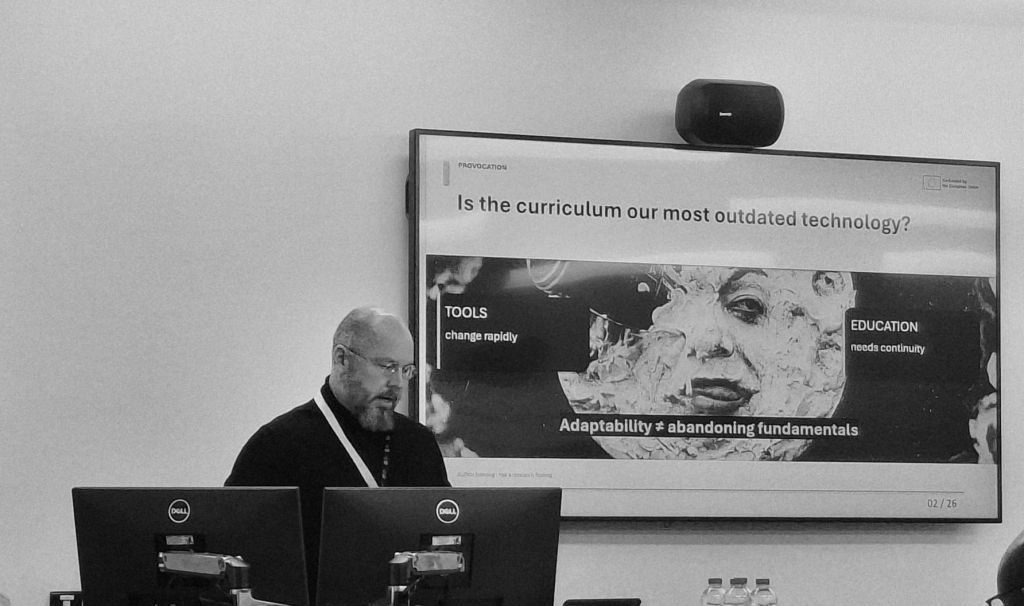
I opened my talk with a deliberately provocative question: Is the curriculum perhaps the most outdated technology in film education? This question does not imply that curricula or traditional film education have lost their significance. Quite the contrary. The fundamentals of cinematic expression, dramaturgy, visual storytelling, collaboration and artistic judgement remain at the heart of education. The curriculum also forms the basis for the quality of education, its objectives and equal learning opportunities for students. The critical question is therefore not whether we need a curriculum, but how well its structures are able to adapt to the changing nature of filmmaking.
From linear production towards iterative processes
Traditionally, film production is described as a step-by-step process: screenplay, pre-production, shooting, post-production and distribution. In reality, filmmaking has never been entirely linear, but virtual production is changing the relationships between these stages.
Subscribe to DeepL Pro to edit this document. Visit www.DeepL.com/pro for more information.
With the help of game engines, digital environments, camera tracking and pre-visualisation, a film’s visual and technical solutions can be tested well before actual filming begins. At the same time, some of the decisions traditionally made in post-production are being brought forward to earlier stages of production. The production process is becoming a more iterative whole, in which planning, experimentation and the evaluation of creative solutions can overlap.
This change also affects collaboration within the production team. The cinematographer, production designer, director, producer and designers of virtual environments must find a common creative language at an early stage. From the cinematographer’s perspective, for example, this change does not diminish the importance of light, optics, composition or camera movement as tools of visual storytelling. On the contrary: it opens up new possibilities for their creative use and challenges us to consider at what stage and in collaboration with whom the film’s visual world is constructed. Not everyone needs to master everything, but everyone must understand the work of others sufficiently to be able to do their own job well.
Non-linearity does not mean a lack of structure
The pedagogical structure of film education has traditionally progressed from the basics to discipline-specific expertise and on to increasingly demanding productions. This model has provided a coherent way of learning a complex artistic and technical profession. However, filmmaking has always involved experimentation, revisiting previous solutions and the overlapping of different stages of work. New production technologies make these processes more visible than ever, whilst at the same time challenging us to rethink the sequence of learning.
Behind non-linear pedagogy lie several complementary perspectives on learning theory. In David Kolb’s (1984) experiential learning, experience, reflection, conceptualisation and further experimentation form a continuous process. In Seymour Papert’s (1980) constructivism, learning is facilitated by the construction of meaningful outputs, whilst Chow and colleagues’ (2016) non-linear pedagogy emphasises the interaction between the learner, the task and the environment. The research roots of the latter approach lie particularly in the learning of motor skills; consequently, its application to film education requires pedagogical interpretation.
The Samsara pedagogical framework of the FilmEU university alliance brings the perspective of higher education in the arts and media into the discussion. It provides a basis for combining experiential learning, artistic research, collaborative working and student-centred learning processes (Baltazar et al., 2021). The significance of Samsara for film education lies particularly in the fact that learning can be viewed not as a series of individual course modules, but as a creative and reflective process in which practice, research and the construction of new understanding are interlinked.
A recent study on training in virtual production also supports the need for a pedagogical reassessment. In their extensive literature and curriculum review, Rodolfo Anes Silveira and his colleagues (2026) examine the role of virtual production in film education. The study highlights the tension between technical and industry-oriented skills on the one hand, and artistic experimentation, critical reflection and pedagogical development on the other. This observation is crucial: teaching new production methods does not, in itself, explain how they can be used to learn how to think about and make films.
A non-linear production process does not, therefore, automatically lead to non-linear learning. A virtual studio or game engine is not, in itself, a pedagogical method. Instead, a student may encounter a complex cinematic problem at an early stage, try out different solutions, assess their narrative and technical implications, and revisit their plans in the light of new insights. What matters is not just what the student produces, but how they learn to justify their creative choices.
Non-linearity does not, therefore, mean abandoning goals or a structured approach. On the contrary: it emphasises the teacher’s ability to design meaningful learning situations, guide reflection and recognise the development of competence. The teacher’s role expands from that of a conveyor of knowledge and professional skills to that of a designer of the learning process, a mentor and a critical discussion partner who supports the development of the student’s artistic thinking and professional identity.
Artificial intelligence also challenges the values of film education
Alongside virtual production, artificial intelligence was one of the most prominent topics of discussion at the Dublin congress. In addition to the technological possibilities, the presentations examined authorship, creative autonomy, changing professional roles and the responsibility of education in a context where the use of artificial intelligence in the audiovisual sector is developing rapidly.
A particularly interesting perspective was offered by Neil Peplow, an expert in film education and the audiovisual sector, in his presentation ‘What Graduates Will Walk Into: How the Screen Industry Is Really Adopting AI’. The pilot survey of 125 respondents he presented highlighted the tension between technological developments in the sector and students’ attitudes. Whilst companies are adopting artificial intelligence, students may be considerably more cautious about its use, for example due to concerns regarding copyright, artistic ownership and professional ethics.
This presents a pedagogically interesting challenge for film education. It is important for students to understand the kinds of technologies and working methods they may encounter in their professional lives, but at the same time, their education must support their ability to make independent and informed choices about how to use them. AI literacy cannot simply mean technical mastery of new tools.
The wider discussion at the conference reinforced my own view that the role of film education is not to adapt uncritically to every technological change. It must also equip students with the skills to assess when new technology serves an artistic purpose, when it alters the conditions of creative work, and when choosing not to use it may be a justified decision.
From the production studio to virtual production learning environments
In the film programme at Turku University of Applied Sciences, learning by doing and student productions play a central role. The Academy of Arts’ Production House serves as a production-based learning environment, where students gradually take part in increasingly demanding film productions. Professional competence is built through repetition, peer learning, collaboration between different year groups and practical production experience.
However, production success and pedagogical success are not one and the same. A film may be completed on schedule, even if significant learning opportunities are left untapped. Conversely, a pedagogically valuable experiment may involve setbacks and changes of direction for which there would not always be scope in professional production. The role of education is to recognise when production efficiency supports learning and when it begins to restrict it.
The pedagogical development of virtual production does not aim to replace this operating model, but to complement it. In the European Cutting Edges project, we are investigating how virtual production methods can be integrated into film and media education across different learning environments and with varying technical resources.
One of the areas of development is the Studio Access Model, which examines virtual production learning environments through five different usage and accessibility models (XS–XL). The central idea behind the model is that high-quality teaching in virtual production does not necessarily require the educational institution to have its own large LED studio. What is more essential for learning is how technology, expertise, pedagogical objectives and collaborative networks are combined. The models do not describe levels of teaching quality or a prescribed sequence of progression, but rather different ways of organising virtual production learning based on available resources and pedagogical objectives.
The Creative Media Lab currently under development at Turku University of Applied Sciences is being built on a modular basis around, amongst other things, a chroma key studio, camera tracking, the Unreal Engine game engine and post-production learning environments. The aim is to create an environment for teaching, research and artistic experimentation, where students can test their ideas, visualise scenes and evaluate their creative solutions before actual production.
Collaboration with professional studios, such as the Finnish company Fireframe, enables plans developed within the learning environment to be taken forward into practical studio production. At the same time, students are able to observe how solutions developed through the institution’s own experiments function in a professional production environment. The connection between these different operating environments is one of the most interesting pedagogical questions in our development work.
International collaboration yields concrete learning content
The Cutting Edges project has developed over 20 pilot courses or learning modules related to virtual production, covering topics ranging from film narrative and animation to game engines, virtual environments, production and post-production. The aim of the project is not to create a one-size-fits-all curriculum, but to explore how different educational institutions can develop teaching in virtual production based on their own starting points.
In November 2026, FilmEU published a news item on the virtual production learning modules produced as part of the Cutting Edges project. The programme is divided into four educational areas: core virtual production skills for film schools; multidisciplinary virtual production and artificial intelligence skills for media and arts students; broad-based professional skills for the digital age; and micro-courses aimed at industry professionals and freelancers.
The published modules represent a tangible outcome of international teaching development work. Alongside these, practical pilot implementations are continuing, enabling us to assess the effectiveness of the learning environments, the development of students’ skills, and the applicability of the methods to various educational contexts.
The Dublin conference provided an opportunity to examine this development work within a broader international dialogue. Following my own presentation, eight participants responded to a small-scale feedback survey I conducted, seven of whom expressed a clear interest in future collaboration. Although the results of the survey cannot be generalised more widely, they indicate that the pedagogical issues we presented also aroused interest outside our own project network.
The contacts and discussions that arose during the conference opened up opportunities to continue collaboration, for example in the form of pedagogical development, research and teacher exchanges. Such encounters are particularly valuable when they allow us to compare the operating models of different educational institutions and bring new perspectives to our own teaching.
Building the future of film education together
The international scholarly dialogue initiated at the congress continues through publications. CILECT and the International Journal of Film and Media Arts have collaborated on a special issue entitled ‘Film Education: ReMastered’, covering topics such as pedagogical renewal, artificial intelligence, authorship and changing models of education. The pedagogy of virtual production is closely linked to this debate, although its educational implications still need to be explored in greater depth.
For me, the discussions I had in Dublin reinforced the idea that the future of film education cannot be determined solely by new equipment purchases or technical updates to the curriculum. We also need a research-based understanding of how students learn, what skills changing production processes require, and how artistic thinking can be kept at the heart of education.
In the pedagogical development work of the Cutting Edges project, we have outlined an approach based on experimentation, testing, teaching, reflection and iteration. This is still a work in progress, and its effectiveness and learning outcomes will need to be assessed as the project’s pilot phases progress. The aim is to develop learning environments where students have the opportunity to revisit their previous solutions, compare alternatives and learn from both successes and failures.
The future of film education may not ultimately hinge on how quickly new technologies are integrated into teaching. What may be more decisive is how well the education equips future filmmakers to understand, question and innovate both the technologies themselves and the underlying practices.
The film school of the future need not abandon its traditions. However, it must be able to assess them critically. Perhaps, then, the curriculum is not the most outdated aspect of film education after all. What may be outdated, however, is the idea that learning always proceeds in a predetermined order, that skills develop in separate, isolated areas, and that the creative process can be divided into unchanging stages.
The most important innovation in the film education of the future may not necessarily be new technology, but rather the ability to build learning environments in which the education itself can continually learn and evolve. A strong professional foundation, a shared creative language and critical experimentation form the basis for film education that is capable of renewing itself without losing its own identity.
Author
Marko Luukkonen is a lecturer specialising in film at the Turku University of Applied Sciences’ Academy of Arts and a member of the Film and Media Research Group. He works on the pedagogical development of film education, student productions and virtual production, and participates in the international Cutting Edges project.
On the use of artificial intelligence
Artificial intelligence has been utilised in the development of the article’s structure, versioning and linguistic editing. The article’s perspectives, interpretations and content are the author’s own.
Sources and further information
Baltazar, J., Carroll, L., Damásio, M. J., Faleiro Rodrigues, É., O’Toole, D., Roper, R., Van Landuyt, A., & Vandewalle, M. (2021). Handbook: Pedagogical strategies and guidelines
(D2.2). FilmEU European Universities Alliance. https://www.filmeu.eu/images/files/D-2.2-Handbook-Pedagogical-Strategies-and-Guidelines.pdf
Chow, J. Y., Davids, K., Button, C., & Renshaw, I. (2016). Nonlinear pedagogy in skill acquisition: An introduction. Routledge.
Cutting Edges. (n.d.). Cutting Edges – Virtual production education project. https://cuttingedges.filmeu.eu/
CILECT Congress 2026. (2026). Keynotes. https://www.cilectcongress2026.com/keynotes
FilmEU. (9 November 2026). Cutting Edges publish virtual production modules. https://www.filmeu.eu/news/cutting-edges-publish-virtual-production-modules
Institute of Art, Design + Technology. (2026). CILECT Congress 2026: Film Education ReMastered. https://research.iadt.ie/en/activities/cilect-congress-2026-film-education-remastered/
International Journal of Film and Media Arts. (2026, 10 February). Call for papers: Vol. 12 No. 1 (2027): Film Education: ReMastered. https://revistas.ulusofona.pt/index.php/ijfma/announcement/view/257
Kolb, D. A. (1984). Experiential learning: Experience as the source of learning and development. Prentice-Hall.
Luukkonen, M. (27 October 2026). Pedagogical transitions: Rethinking film education for a non-linear future [Conference presentation]. CILECT Congress 2026, Dublin, Ireland.
Papert, S. (1980). Mindstorms: Children, computers, and powerful ideas. Basic Books.
Silveira, R. A., São Mamede, H., & Santos, A. (2026). Virtual production education in film curricula: Scope, methods, and pedagogies – A systematic multivocal review. Convergence: The International Journal of Research into New Media Technologies, 32(2), 249–288. https://doi.org/10.1177/13548565261426105
Stanelyte, R. (2026, 30 October). 300 film school people in one place! FilmEU CommUnity. https://community.filmeu.eu/news/300-film-school-people-one-place